How’s it going, readers?
I’ll start today with a quote “do the work you want to do and that’s the work you’ll get, do the work you don’t want to do and that’s the work you’ll get”
I want to talk about one of the biggest lessons I’ve learned as a professional artist. I recently had an experience with a client that helped me understand something I’ve struggled with for most of my career: the kind of work I take on matters just as much as the work I’m capable of doing.
I’ve been doing work for hire since I was 18. I’ve been trying to make a living through art for as long as I can remember. Over the years, that has meant all kinds of projects: some more ambitious and high-profile, others quick and dirty. I’ve hustled for jobs, painted murals, worked with businesses, and taken on projects because I needed the money or wanted to build a name for myself.
But there’s something I’ve consistently struggled with.
I’ve often found myself hating the very work I’ve worked so hard to get.
For a long time, I couldn’t quite put my finger on why. I knew I didn’t always enjoy the process, but I figured that was just part of being a professional artist. You take the good with the bad. You do the work, you get paid, and you keep moving.
I think I’ve finally gotten closer to understanding what’s actually going on.
The idea: Peeps in the Burg
Recently, I applied for a local grant to fund a mural project. But rather than pitching another large commissioned mural, I wanted to try something different.
I’d recently been talking with my stepmom, who’s a dog groomer. She can book an appointment, spend an hour grooming a dog, make her money, and move on to the next one. There’s a simplicity to that model that I found appealing.
As an artist, I can sometimes make a decent hourly rate on a project, but the scope of the work makes it difficult to keep things contained. A mural might take weeks or even months when you account for planning, meetings, revisions, logistics, and execution.
I started asking myself: What would the equivalent of a one-hour dog grooming appointment look like for an artist?
Obviously, I might not finish a painting in an hour. But what if I could create something meaningful in five or ten hours rather than committing to a project that consumes an entire month?
I wanted to get away from painting big rectangles just because someone had a wall that needed filling.
That’s where Peeps in the Burg came from.
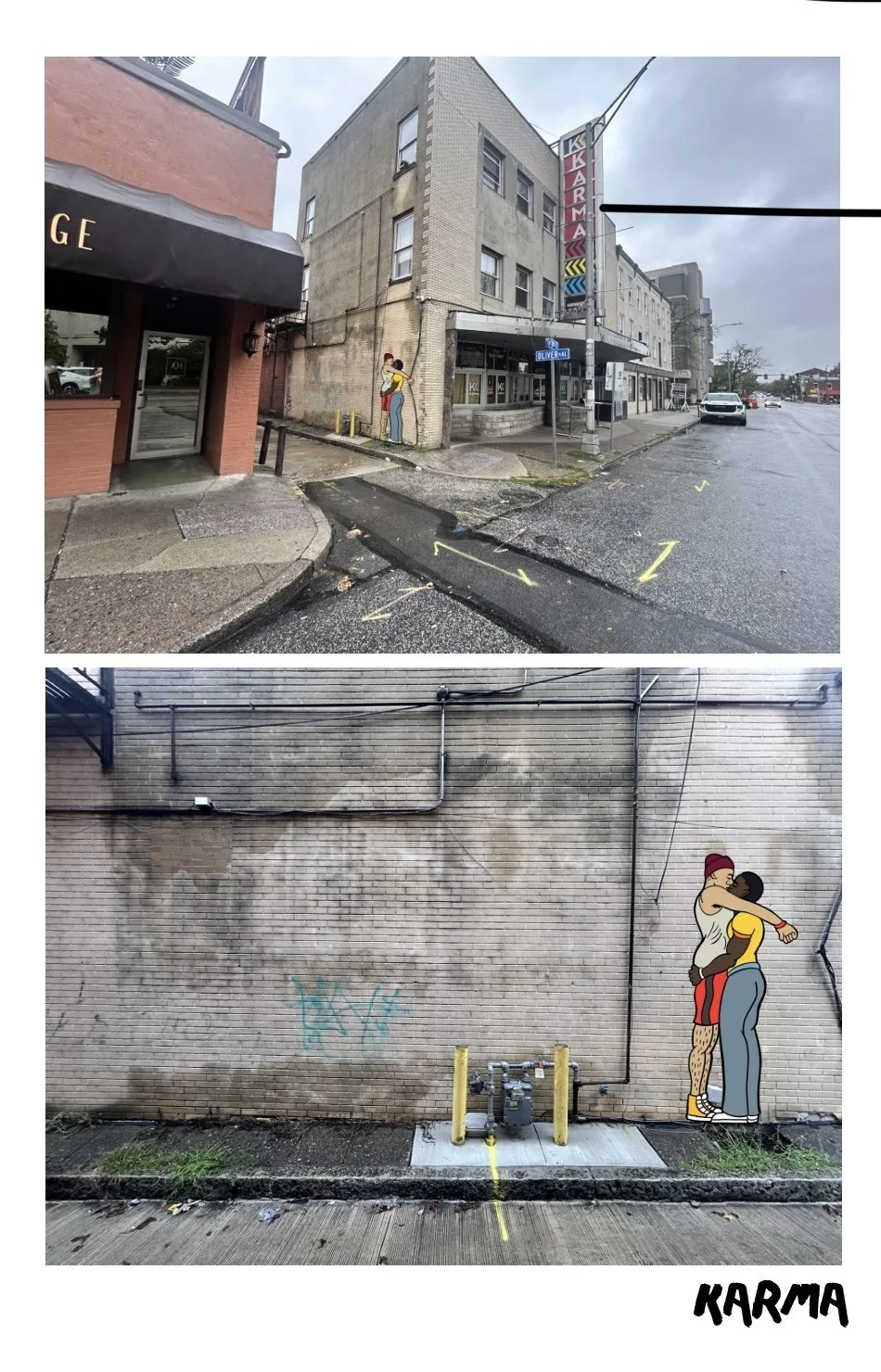
The idea is simple: paint small portraits of everyday people around Harrisburg and install them throughout the city. Start with one location, build some local interest, and hopefully let the project grow organically into a larger citywide series.
I was genuinely excited about this idea. It was something I came up with, something I wanted to see exist, and something that felt like it could grow into its own little world.
It was also self-contained. I could complete individual pieces in an afternoon, document the process, and build something over time without having to put my entire life on hold.
That was the point.
When the project stopped being mine
I eventually got connected with a local club called Karma, which was interested in participating in the grant program.
When I met with the owner, I realized he wasn’t particularly familiar with my Peeps in the Burg concept. He knew they wanted a mural, and he was interested in having one done. So the conversation started moving in that direction.
He had his own idea for what he wanted to see, and I found myself doing what I’ve done countless times before: figuring out how to bring a client’s vision to life.
There’s nothing inherently wrong with that. It’s part of working with clients. And there was even a part of me that was interested in the idea.
But something changed.
The original excitement I had about the project started to disappear. I found myself dragging my feet. I wasn’t particularly motivated to follow up, and every additional logistical hurdle seemed to make the project feel heavier.
Over the next month, I worked through conversations about the grant, approvals, logistics, and what it would take to make the mural happen.
And somewhere along the way, I had gone from proposing a small, self-contained series of portraits to planning the kind of large commissioned project I’d been trying to move away from.
I hadn’t really noticed how far I’d drifted from my original intention.
The moment it clicked
Eventually, I needed to follow up with the grant organization to clarify some details.
I had been hesitant to make the call. If I’m being honest, part of me didn’t want the project to move forward. I didn’t want to take responsibility for something I wasn’t particularly excited about.
But I made the call anyway.
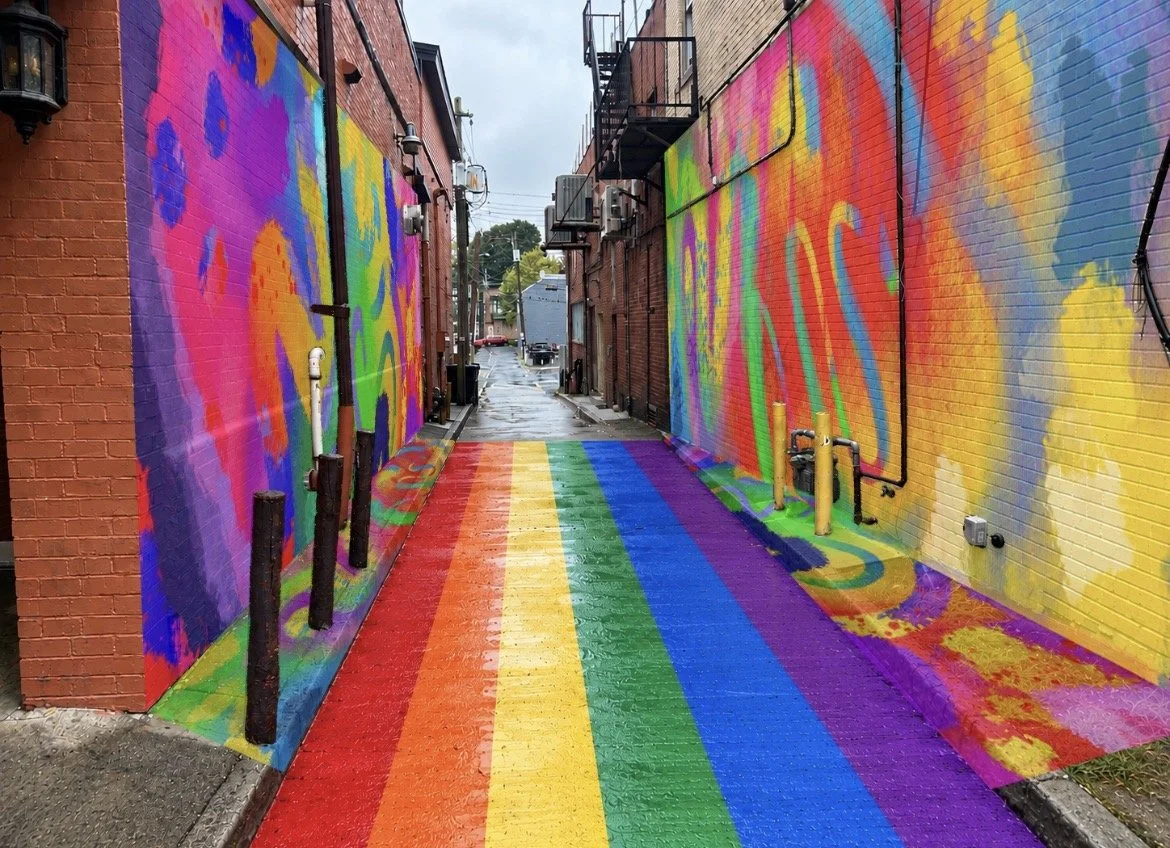
That’s when I learned that the original concept for the project wasn’t going to work in that location. The grant organization could fund the mural, but we weren’t permitted to paint on the ground, which was an important part of the client’s proposed design.
We could, however, paint the wall.
And suddenly, I felt an enormous sense of relief.
The part of the project I had been struggling to get excited about was no longer on the table. I didn’t have to figure out how to make that particular vision work.
Instead, I could return to the idea I had originally pitched.
I reached back out to the club owner and asked whether we could do Peeps in the Burg instead. He responded enthusiastically. The grant organization was also willing to hold the funding until spring while we worked out the details.
Just like that, the project was back on track in a direction I was actually excited about.
I don’t want to make this story about blaming the client. He had an idea for his space, and there’s nothing wrong with that. This isn’t a criticism of him or his business.
It’s about recognizing my own relationship with the work I take on.
I’m an ideas guy
After sitting down and journaling about the experience, I think I finally identified something important about myself.
I’m an ideas guy.
I love coming up with concepts. I love thinking about how art can interact with a space, a community, or an audience. I love developing a visual language and figuring out how to bring an idea into the world.
And I want people to approach me because they value that.
I don’t necessarily want to be the hired hand who gets called whenever someone has a wall that needs painting. I want to be an artist whose creative perspective is part of the reason they’re making the call in the first place.
There’s a difference between someone hiring you because they need a muralist and someone approaching you because they want your ideas.
I’ve spent a lot of my career proving that I can execute. I can take someone else’s concept, figure out the logistics, solve the problems, and make it happen.
But I don’t think that’s where I want to spend the rest of my creative life.
And I think this explains a lot of the frustration I’ve experienced over the years.
When I’m not interested in a project, I can feel myself going through the motions. I start doing the work because I want to get it over the line and get paid. I lose the enthusiasm that allows me to tap into the parts of myself that make my work special.
Sometimes the finished product still looks good. But I know when I’ve put something out that doesn’t represent my best work.
I can look back at projects in my portfolio and recognize that I took them because I thought I had to. And I wonder how much stronger my body of work might have been if I’d been more selective.
I don’t regret those jobs. I needed the experience, the money, and the opportunities. I needed to develop my skills and establish myself.
But I’m at a different point in my career now.
Building a market for the work I want to make
I think there’s an important distinction between an emerging artist and someone entering the middle of their career.
When you’re starting out, there’s a lot of value in taking opportunities, building experience, developing your portfolio, and learning how to work with clients. You need to prove that you can deliver.
But at some point, I think the goal should start to shift.
Rather than simply finding more people who need the skills you have, you start building a market for the ideas and perspective you bring to the table.
That’s something I’ve been thinking about a lot lately.
I want to work with organizations that seek me out because they appreciate my work. I want to develop projects that I’m personally invested in. I want to create art that reflects my interests, my sense of humor, my ideas, and the things I want to communicate.
I want to be more selective about the work I accept, not because I’m above doing commissioned work, but because I want to protect the time and energy I have for making good work.
And I think there’s a business case for that, too.
If I build a reputation around a particular creative perspective, I may be able to attract better opportunities and command higher fees. People aren’t just paying for the hours it takes to paint something. They’re paying for the ideas, experience, and creative judgment that go into it.
I would much rather complete two projects a year that I’m genuinely excited about than spend the year producing work that leaves me feeling disconnected from my own portfolio.
That’s not necessarily a rejection of client work. It’s a change in what I want client work to look like.
A different standard for myself
I think the biggest takeaway from this experience is that I need to start trusting my own ideas more.
I don’t have to accept every opportunity simply because I’m capable of doing the work. I don’t have to abandon an idea I believe in just because someone presents me with a different one. And I don’t have to make myself responsible for bringing every client’s vision to life.
I can collaborate. I can listen. I can be flexible. But I also get to have convictions about the work I want to make.
And maybe that’s one of the most important transitions I’m making as an artist.
For a long time, I was trying to establish myself by proving how much I could do. Now I want to establish myself by becoming more intentional about what I do.
I want to build a body of work that I’m proud of. I want to work with people who value my perspective. And I want to create a professional life that leaves me excited to get into the studio rather than constantly looking for the finish line.
Peeps in the Burg is a small project, but it represents something much bigger to me.
It’s a reminder that I can have an idea, believe in it, and pursue it. I don’t have to wait for someone else to tell me what to make.
And I don’t have to take every job just because it comes along.
I want to make the work I actually want to make. And I think it’s time I started building my business around that.